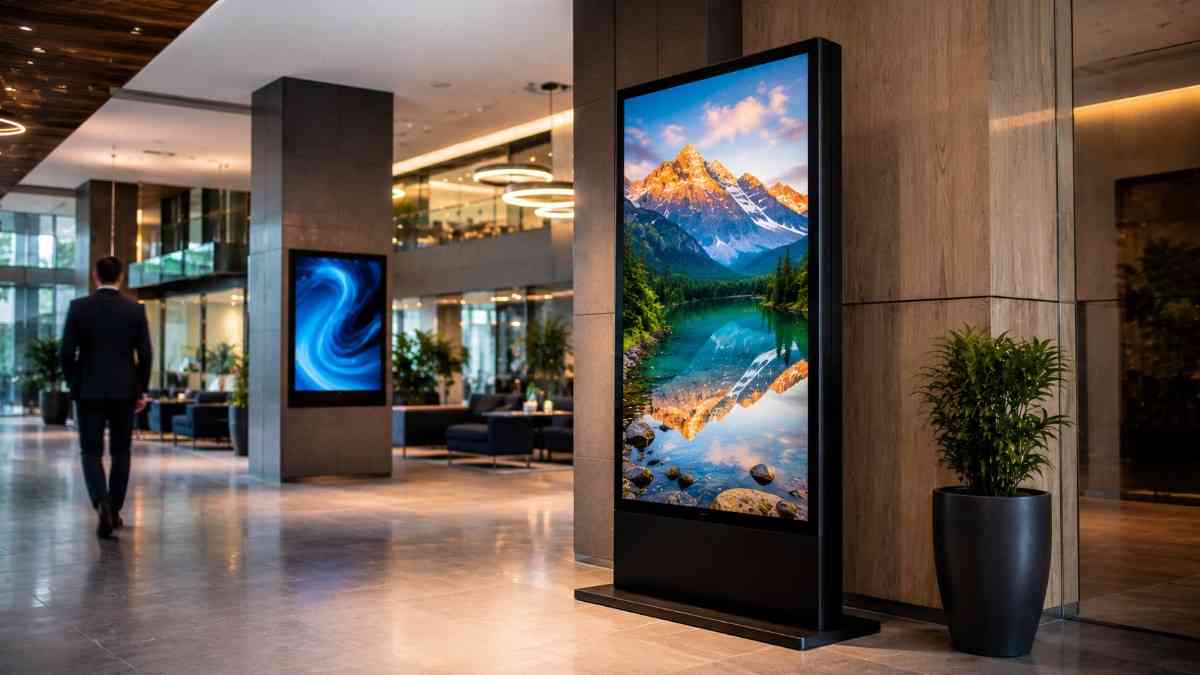
This guide covers everything you need to know about digital signage and displays in a practical, no-nonsense way. What the technology actually is, how it works, which types suit which businesses, what specifications matter, and how to avoid the mistakes that cost businesses money. Whether you are completely new to the category or looking to upgrade an existing setup, this is the resource to start with.
What Digital Signage and Displays Actually Mean for Your Business
The term gets used broadly, so it is worth being specific. Digital signage and displays refers to screen-based communication systems used in commercial and public environments to present dynamic content including images, video, live data feeds, and scheduled messaging.
The defining characteristic is that the content is digital and updateable. Unlike a printed sign that says what it says until someone replaces it, a digital display can show something different every hour, every day, or every season, all managed remotely from a single platform without anyone physically touching the screen.
That flexibility is the core value proposition. And it compounds over time as you get better at using the system.
A study by Arbitron found that digital signage and displays capture the attention of 63 percent of people who pass them, and 29 percent of those viewers go on to make a purchase based on what they saw. Those are not trivial numbers. That is a meaningful chain of influence operating continuously in your physical environment.
How Digital Signage and Display Systems Are Structured
Understanding the architecture helps you ask better questions and make smarter buying decisions.
The Display Hardware
The screen is the most visible component. For commercial digital signage applications, commercial-grade displays are the only appropriate choice. These are purpose-built for extended operating hours, higher brightness requirements, better thermal management, and the demands of continuous business use.
Consumer televisions look similar but are engineered to a fundamentally different duty cycle. Using a consumer screen in a commercial signage context typically results in early failure, poor visibility in ambient light, and warranty issues when the manufacturer identifies the usage pattern.
Screen sizes range from compact 32-inch units suited to countertop or close-viewing applications, through to large-format 98-inch and above installations for high-impact wall displays, outdoor-facing windows, and large venue applications.
The Media Player
The media player is the device that stores and delivers content to the screen. It connects to the display and pulls content either from local storage or from a cloud-based content management system. In simpler setups it is a separate small device. In more integrated commercial systems it is often built directly into the screen, reducing the number of components to manage and potential failure points.
The Content Management System
This is where you actually control your displays. A good cloud-based content management system allows you to create and upload content, schedule it for specific dates and times, push updates to individual screens or entire networks simultaneously, and monitor screen status remotely.
When I tried working with an older locally-hosted content management system on a project for a mid-sized retail client, every content update required either remote desktop access or a physical visit to the server. Transitioning to a cloud-based platform reduced update time from an hour-long process to less than five minutes, regardless of where I was or how many screens needed updating.
Types of Digital Signage and Displays Worth Knowing About
Different business needs call for different solutions. Here is how the main categories map to real applications.
Indoor Digital Signage Displays
The most widely deployed category. Indoor digital displays are used in retail stores, corporate offices, hospitality venues, healthcare facilities, educational institutions, and public buildings. They operate in controlled environments where temperature, humidity, and exposure to the elements are managed.
Indoor commercial displays are available in a wide range of sizes, aspect ratios, and brightness levels. The key specifications to match to your environment are screen size relative to viewing distance, brightness relative to ambient light levels, and orientation based on how the content and space will work together.
In my experience, businesses that take the time to properly assess viewing distances and ambient light conditions before buying indoor displays consistently end up with more effective installations than those who choose screens based on price or size alone.
Outdoor Digital Signage Displays
Outdoor deployments require hardware built specifically for the challenges of being exposed to weather, direct sunlight, temperature extremes, and in coastal environments, salt air corrosion.
Key requirements for outdoor digital signage displays include IP65 or higher weather protection ratings, brightness of at least 2500 nits for shaded outdoor locations and 3500 nits or above for north-facing or direct sun exposure, corrosion-resistant housing, and thermal management systems that handle both summer heat and winter cold.
New Zealand's climate is variable and in many regions genuinely demanding. Outdoor displays specified correctly for NZ conditions perform reliably for many years. Those that cut corners on weatherproofing or brightness tend to fail within the first year of operation.
Digital Menu Board Displays
Digital menu boards are a specific application of digital signage technology tailored to the needs of hospitality businesses. Restaurants, cafes, takeaways, food courts, and beverage outlets use digital menu boards to display their offerings, promote specials, and manage the transition between daypart menus automatically.
The operational benefits are substantial. Menu changes that previously required reprinting and redistributing printed materials can be made in minutes from any device with an internet connection. Seasonal menus, limited-time offers, and sold-out item removals all happen in real time without any disruption to service.
Dynamic Displays has installed digital menu board systems for hospitality businesses across New Zealand and the operational feedback is consistent: the time saved on menu management alone makes the investment worthwhile, before any consideration of the uplift in sales that better visual presentation delivers.
Corporate and Meeting Room Displays
Corporate environments use digital signage and display technology across a range of functions beyond simple promotion. Lobby screens communicate company information, achievements, and visitor directions. Meeting room panels show booking status and calendar integration. Internal communications screens keep staff informed across large or multi-floor workspaces.
Corporate digital display systems contribute meaningfully to how an organisation feels to work in and how it presents to external visitors. A building with clear, well-designed digital information displays communicates organisation and professionalism in a way that printed notices and whiteboard directories simply cannot.
Interactive Digital Displays
Interactive displays add touchscreen capability to the standard digital signage format. Users can engage directly with the screen to navigate information, explore product catalogues, access wayfinding directories, or complete self-service transactions.
Interactive digital signage is particularly valuable in retail showrooms, museums, educational institutions, healthcare settings, and any environment where visitors need to access information independently. Engagement rates with interactive displays are significantly higher than with passive screens because the user is actively participating rather than passively receiving.
Portable and Freestanding Digital Displays
Freestanding digital display units on floor stands or portable bases offer flexibility that wall-mounted installations cannot. They can be repositioned to suit changing floor layouts, moved between locations for events, or used temporarily in spaces that do not warrant a permanent installation.
Portable digital displays are standard equipment for exhibition and trade show environments in New Zealand. The ability to set up a high-impact digital presence quickly and without permanent installation makes them a practical choice for businesses that participate in events regularly.
The Real Benefits of Digital Signage and Displays for Business
Here is a direct and honest account of what businesses actually gain from switching to digital signage and displays.
Faster communication. When something changes in your business, your signage can reflect it immediately. A new product, a changed promotion, a sold-out item, a new operating hour. No lag, no reprinting, no outdated information confusing customers.
Better customer engagement. Moving images, dynamic content, and well-designed visuals hold attention in a way that static materials do not. This translates directly to greater awareness of promotions, products, and services among customers who are already in your space.
Consistent brand presentation. A centrally managed digital signage network ensures every location and every screen shows content that meets your brand standards. No faded posters, no off-brand promotional materials, no inconsistencies between locations.
Reduced long-term operational costs. The cumulative cost of printing, distributing, and replacing printed promotional materials over two to three years typically exceeds the cost of a well-specified digital signage installation. The crossover point arrives sooner than most businesses expect.
Multi-location management from one place. A business with three locations, ten locations, or fifty locations can manage all of their digital displays from a single content management dashboard. The same update goes everywhere simultaneously, or different content goes to different locations based on rules you set in advance.
Common Mistakes Businesses Make with Digital Signage and Displays
I have noticed these errors repeatedly, and they are all avoidable with proper planning.
Treating it as a one-time setup. Digital signage delivers ongoing value only when the content is kept current and relevant. Businesses that install screens and then leave the same content running for months lose most of the benefit of the technology.
Using the wrong hardware for the environment. Consumer screens in commercial settings, indoor screens in outdoor positions, low-brightness displays in high-ambient-light environments. All of these result in poor performance and early replacement costs.
Neglecting content quality. Low-resolution images, poor design, and overcrowded layouts undermine the impact of even excellent hardware. The screen is only as effective as the content running on it.
Buying without a content plan. Many businesses focus entirely on the hardware decision and give no thought to who will create content, how often it will be updated, or what the workflow for managing it will look like. This leads to screens showing stale or irrelevant content shortly after installation.
Choosing a provider with no local presence. When something needs attention, you need someone who can respond. An overseas supplier with no New Zealand presence cannot provide the local support that keeps a commercial digital signage installation running reliably.
What to Look for in a Digital Signage and Display Provider in NZ
The qualities that separate genuinely good providers from average ones are not complicated, but they are worth checking explicitly.
A good provider starts with your situation, not their product catalogue. They assess your environment, understand your communication goals, and recommend solutions based on what will actually work for you.
They specify commercial-grade hardware from reputable manufacturers. They have a workable content management solution that your team can use without needing technical expertise. They install professionally with proper cable management, secure mounting, and full system configuration. And they support you after installation with responsive local service.
Dynamic Displays has built its reputation in New Zealand on exactly this approach. With over a decade of experience and more than 200 projects delivered across retail, hospitality, corporate, and events sectors nationwide, they bring practical local knowledge to every project that makes a tangible difference in outcomes.
Getting the Best Long-Term Results from Your Digital Signage Investment
The businesses that get the most sustained value from digital signage and displays are those that stay actively engaged with their content strategy.
Build a simple content calendar. Plan what your screens will show across the coming weeks and months, aligned with your promotions, events, and seasonal activity. This removes the inertia that leads to stale content and keeps your displays relevant and effective.
Invest in decent creative. You do not need a full-time designer, but having a set of well-designed templates for your common content types makes every update faster, more consistent, and more professional.
Use scheduling intelligently. Most content management platforms allow you to schedule content in advance by date, time, and screen. A breakfast promotion that automatically appears at 7am and disappears at 11am is far more effective and far less labour-intensive than manually updating screens at the start of each day.
Review and measure. If you run a promotion exclusively through your digital displays, track its performance through your sales data during that period. Build up a picture over time of what content formats and messages perform best for your specific audience.
Digital signage and displays are not a future technology. They are a present-day business tool that New Zealand businesses of every size and industry are using to communicate more effectively, engage customers more deeply, and operate more efficiently.
If you are ready to explore what the right digital signage and display solution could do for your specific business, the team at Dynamic Displays is ready to help with a proper assessment and an honest conversation about what will work best for your environment and goals.
Related Pages and Next Steps
Compare related options before you decide: digital signage NZ, commercial displays, digital signage installation and Digital Signage Solutions for Business: A Plain Guide.
Not sure which option suits your site? Contact Dynamic Displays for advice and a quote.